































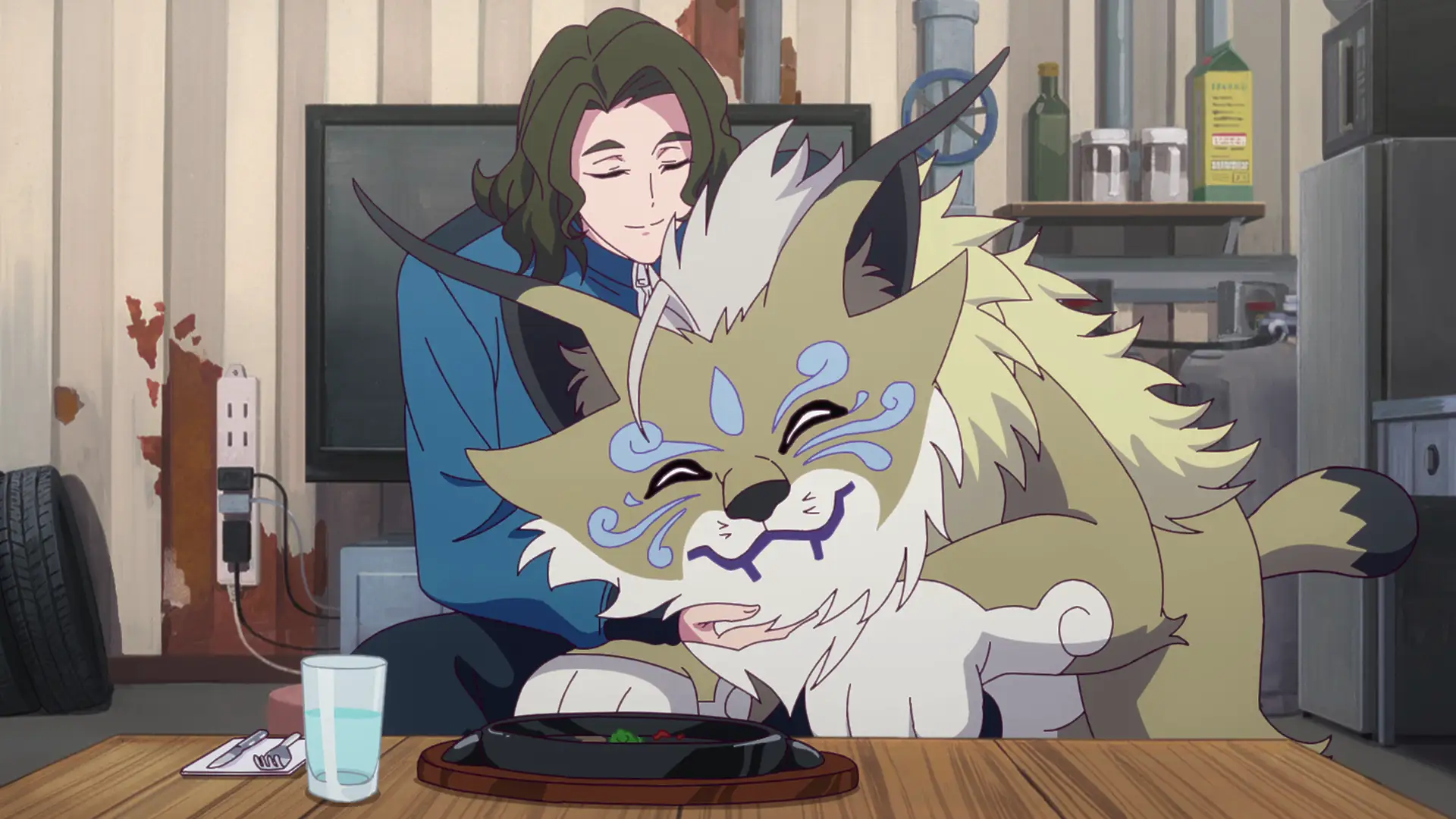
Two voice actors who grew up right in the middle of the Digimon boom are now carrying the franchise into a new era. In DIGIMON BEATBREAK, Yohei Azakami plays the calm but intense Kyo Sawashiro, while Daiki Hamano voices his partner Digimon, the fully evolved Murasamemon. In this special interview, the two talk about their first impressions of the story, what makes Kyo and Murasamemon’s bond so special, how episodes 7 and 11 dig into Kyo’s past, and why this “Reiwa Digimon” is made to be enjoyed by both kids and longtime fans.
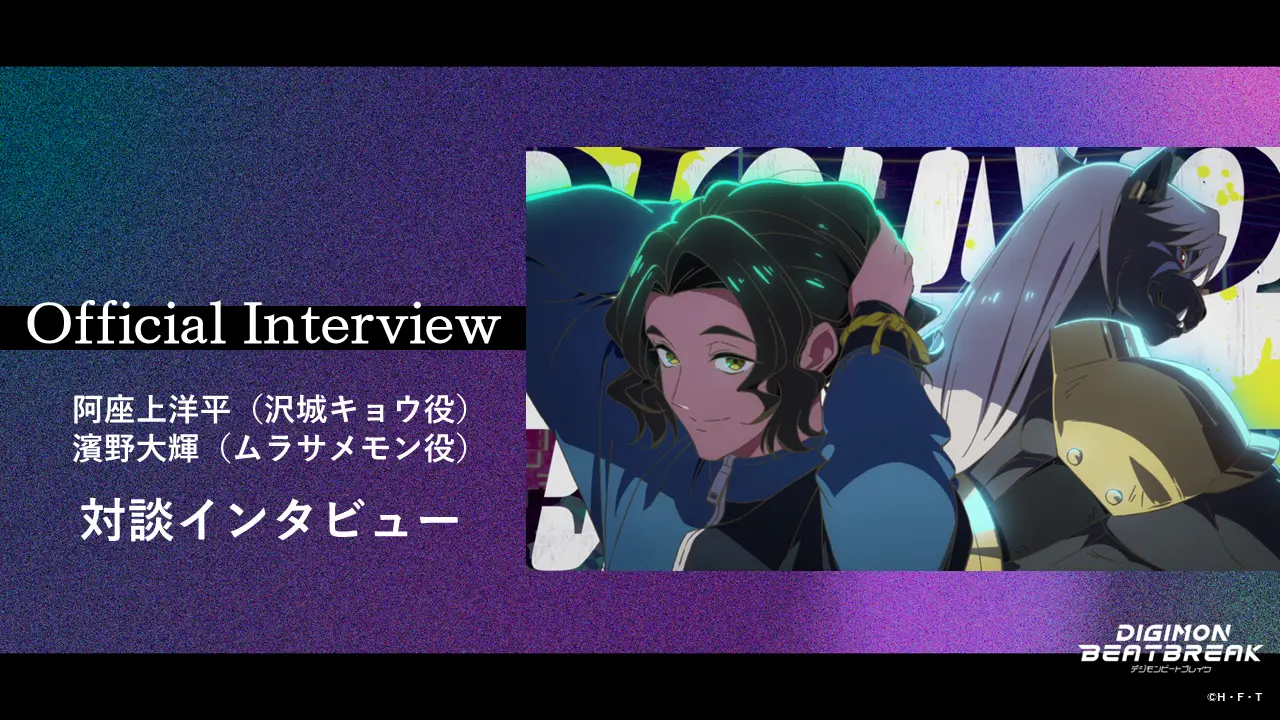
Two Digimon Kids All Grown Up: First Impressions of BEATBREAK
Q: First of all, what was your impression of the series when you read the script?
Yohei Azakami:
I’m right in the middle of the “Digimon generation” myself, so my first reaction was simply, “I get to be part of a new Digimon series again!” The shows I watched obsessively as a kid have been carried on all this time, and now I get to join Digimon at a point where it overlaps with my own career—that feels truly like an honor.
Up until now, my image of Digimon was that it was pop and bright, with lots of cuteness but also that “hot-blooded” feeling that fires up a boy’s heart. But when I read the script for DIGIMON BEATBREAK, I felt that the target age range had been raised a bit, with deeper themes and a kind of drama that can really pull in adults too. And right from episode 1, some pretty heavy events are depicted. The world setting also expands in a different direction compared to past series, so I thought, “This is going to be fun to analyze,” *laughs*. There are hints scattered all over the place, and it feels like the kind of series you want to follow for a long time.
Daiki Hamano:
I also entered the franchise with Digimon Adventure, so when I first read the script I was really surprised that “this isn’t just a story set in the Digital World.” In this show, Digimon naturally exist within everyday life, and with elements like Sapotama and e-Pulse, it’s a very modern update of Digimon. The AI-like Sapotama is closely connected to the story and to the characters’ emotions, which feels very relevant to the times we live in.
The dialogue is very natural as well. Rather than being simplified because it’s “for kids,” it’s written like a proper drama. Of course it’s made to be understandable for children, but adults can be satisfied by it too. It really feels like a “Reiwa-era Digimon series.”
Kyo and Murasamemon as a Tough Big Brother and His Silent Partner
Q: You’re both from the Digimon Adventure generation. Do you have any memories from back then?
Azakami:
I was in the lower grades of elementary school. I’d sit in front of the TV first thing in the morning and watch, and I played with the toys too. Lots of my friends had Pendulums.
Hamano:
Same here—I started with Digimon Adventure, and I saw the movies in real time too. I remember playing with Pendulums and Digivices, and also with the card game and video games.
Azakami:
In DIGIMON BEATBREAK, there are also Digimon from those days who show up in slightly different forms, so I kept going, “Whoa, that’s nostalgic!” and getting hyped, *laughs*.
Hamano:
Seeing Digimon you watched back then reappear in a slightly different form in the present really makes you happy as a fan.
Q: What was your first impression of the characters you play, and how was the audition?
Azakami:
When I first got the audition materials, I was actually planning to read for a different character. In that material, Kyo was in there too. And I thought, “…I want to audition for this guy as well,” and in almost a direct negotiation kind of way, I asked to read for Kyo too.
Characters like Kyo, who stand in that “mentor” or “big brother” position from the protagonist’s point of view, are exactly the kind of roles I wanted to challenge myself with more in this stage of my career. I’d been fortunate enough to be given more and more roles in that kind of position, and it felt like I had met this character Kyo, who is exactly the “show it with your back” type. So I was really happy, but at the same time I was very anxious, wondering, “Can I really pull this off?”
Even from the audition materials, it was written very clearly that Kyo has deep love for his family, and that he absolutely won’t forgive anyone who hurts them. The director also told me, “It’s okay if he feels a little scary and hard to read,” so when I read, I was very conscious of how to carry both that strength and that kindness at the same time.
Hamano:
In my case, from the studio audition stage I was already called in as Murasamemon. I remember thinking, “Oh, I’m not on the human side,” *laughs*, as I read the material. Being a fully evolved Digimon from the start is a pretty aggressive position to be in.
But as I read the script, I realized that Murasamemon is a Digimon that strongly reflects Kyo’s life so far and what he’s been through. How Kyo thinks and feels is directly connected to the way Murasamemon exists. Even though it was an audition, the director gave me really detailed direction as if it were the real thing, so it felt like “the recording sessions had already started from that moment.”
Azakami:
To Tomoro and the others, Kyo is this reliable leader, but he also has fears and weaknesses that he keeps entirely to himself. There are moments when Murasamemon kind of speaks for that side of him, and that makes their relationship really interesting to play.
Design, Figure Dreams and the Cool Appeal of Murasamemon
Q: Now that Murasamemon’s character visual has been revealed, what did you think?
Hamano:
Finally! I was honestly a bit lonely for a while. Other character visuals kept getting revealed one after another, so I kept thinking, “When is mine going to be shown?” And when they opened the lid, it was only Kyo, *laughs*.
Azakami:
The visual was just Kyo, and he was turning back over his shoulder, so it kind of reinforced this idea that “Kyo is definitely the mastermind,” *laughs*. People would say things like, “Where’s his partner?” But later I heard the behind-the-scenes reason that Murasamemon was simply too big to fit into the same visual.
Hamano:
I’ve heard that, like the other characters, there will be chances to show off Murasamemon’s visual at events and such, so I’m really looking forward to that, and I’m very happy.
Q: Murasamemon is a very “Digimon-ish” cool-looking character, isn’t he?
Azakami:
When I first saw the design materials, my impression was, “This is pure concentrated boyish romance.”
Hamano:
Yeah. The armor’s texture and colors, and that almost reverse-jointed three-part leg structure too—it’s a silhouette that just screams “Digimon.” I found myself thinking, “If this ever becomes a figure, it’ll look amazing,” while I was staring at it.
Azakami:
It feels like something that’s very easy to merchandise. Of course, that probably means it’ll cost quite a bit to make, *laughs*.
Hamano:
Someday, somewhere, I’d love for us to show people figures of Kyo and Murasamemon together.
Episodes 7 and 11 Reveal Kyo’s Hidden Strength and Weakness
Q: Episodes 7 “Nirinsou” and 11 “Black Emotions” focus on Kyo. What did you think when you learned about his past, and do you have any memories from recording those episodes?
Hamano:
Those episodes show why Kyo chooses not to delete Digimon, but instead to carry them on his back. The fact that he’s been bearing that reason all by himself—that’s both his strength and his weakness, and I really felt that during the recording.
You can also see that the place where everyone is “kept alive,” where they’re able to really put down roots and live, is the very world Kyo wants to create. That left a strong impression on me.
Azakami:
Kyo is always strong and reliable, but you almost never see his weakness. That can be a little unsettling, and it’s part of why he seems suspicious to some viewers. I think Rena also feels the sadness of not being able to see that hidden side of him.
His line at the end, “Everyone deserves a chance to start over,” shows his belief that even an enemy deserves another chance, and I felt that’s a message that can stick with you no matter your age. In that scene, I tried to play him not only with his usual coolness, but also with his weakness and capacity for compassion.
Q: Episode 11 also reveals that Kyo is from Five Elements Star, right?
Azakami:
The line about him being from Five Elements Star was actually already in the audition script, so I did have this feeling of “Yeah, I thought so.” Considering his strength and position, I always figured he “wouldn’t be just some ordinary guy,” *laughs*. From episode 11, Kaito appears as a sort of rival from Kyo’s Five Elements Star days, and the show starts to dig into Kyo’s past and why he is the way he is now.
It’s also an episode where Kyo, who had basically never tasted defeat before, properly experiences loss, so that’s definitely a highlight.
Hamano:
When a new Digimon like Flaremon shows up as Kyo’s rival, the “shounen” excitement of the battles suddenly ramps up a lot. I hope people enjoy watching how the members of Glowing Dawn grow from here, and also look forward to when all the Ultimate-level Digimon finally gather.
Studio Banter, Serious Takes and Messages for Digimon Fans
Q: Do you have any memorable moments from the recording sessions?
Hamano:
Honestly, every time is fun. Miyu Irino keeps the atmosphere bright, and Megumi Han jumps right in with him, so the studio is always lively, *laughs*.
Azakami:
There was even a time when Irino suddenly said, “I really want to eat pizza now, so let’s order some,” and he actually had it delivered. After that, it was like the staff caught the bug too, and they started bringing all kinds of food, *laughs*.
Hamano:
In a good way, it really feels like a family. But once we start recording, I actually spend more time listening to other people’s dialogue than saying my own lines. That lets me directly feel just how amazing everyone is—the way the atmosphere changes the moment they slip into character and the tension rises. Every time I think, “These are people who are truly on the front lines,” and it’s very stimulating.
At the same time, the vibe is like a boys’ school where the laughter never stops, so it’s very comfortable to be there.
Azakami:
When things get a little too rowdy, Maki’s voice actress, Mie Sonozaki, tells us, “Focus, focus!” and pulls us together. We’re always like, “Sorry!” *laughs*.
Q: Finally, do you have a message for fans who are supporting DIGIMON BEATBREAK, and for people who are thinking about starting the show?
Azakami:
We’re a generation that grew up with Digimon, so we’re carrying that emotion with us as we face this project. At the same time, there are people for whom DIGIMON BEATBREAK will be their very first Digimon, and there are people who used to watch it who are coming back with a sense of nostalgia.
I feel like no matter how you enter this series, there’s something in it that will hit you, so I’d love for you to watch all the way to the end.
Hamano:
I’m truly honored to be able to play Murasamemon in the latest entry in such a long-running series. I hope the people who have followed Digimon up to now, the people starting from DIGIMON BEATBREAK, and the kids watching it in real time can all enjoy it in their own way.
The human drama and Tomoro and his friends’ coming-of-age story are of course important, but the Digimon battles are also incredibly stylish and dynamic this time. With every new episode, the sense of excitement just keeps growing, so if you’re even a little bit curious, I’d be really happy if you started from episode 1 and watched along with us.
For the full Japanese interview, check the official site: Official interview page (JP)
For more on DIGIMON BEATBREAK itself, visit the official English site and watch the main PV on YouTube.
©本郷あきよし・フジテレビ・東映アニメーション
✨✨✨More Anime You’ll Love:
 Digimon Beatbreak Interview: Arisa Sekine and Misaki Kuno on Makoto, Kilopmon, and an Evolution Forged from Feelings
 Android wa Keiken Ninzuu ni Hairimasu ka?? Anime Premieres in Winter 2026
 Masakazu Morita on Ichigo, Hero Pebble Theory and Bleach’s 2026 Final Cour
 TV Anime “Hitozuma no Kuchibiru wa Can Chu-hai no Aji ga Shite” to Air in Summer 2025