



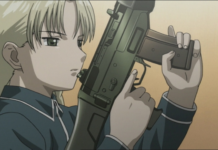




















GUNSLINGER GIRL isn’t a “girls with guns” show that happens to be sad. It’s a story about how tenderness gets processed by a system—filed, measured, and returned as something that looks like love, but isn’t entirely free.
That’s why the series hurts in a specific way. The tragedy isn’t only in the firefights. It’s in the quiet moments when you can almost believe everything is normal—when “small happiness” appears like mercy, and then reveals itself as another kind of cruelty.
The Painful Core That Outlives “Girls With Guns”
The series opens with an image that feels like poetry and threat at once: a girl with a mechanical body, a large gun, and a small happiness. On paper, it sounds like genre dressing. In practice, it’s a thesis statement. The gun is obvious. The “mechanical body” is the price. The “small happiness” is the bait—and the blade.
What makes GUNSLINGER GIRL linger is not how cool the missions look, but how intimate the cost feels. The show keeps asking: if a child is rescued from death, rebuilt into a weapon, and given something that resembles a family… what exactly was saved?
This is where the title’s two ideas meet: manufactured innocence and borrowed humanity. The girls can smile, play, tease, and daydream. But the world around them is engineered to make those human moments functional—useful, containable, and ultimately disposable.
A System That Turns Kindness Into a Transaction
The Social Welfare Agency doesn’t just assign missions; it assigns roles. The girls are paired with adult handlers in “fratello” partnerships—siblings in name, a structure in practice. A handler’s warmth becomes a resource. A girl’s trust becomes an output.
And that is the truly unsettling trick: the system doesn’t need every adult to be monstrous. It only needs ordinary decency to be usable. A gentle word, a cup of something warm, a promise of safety—these can become incentives in a machine designed to produce loyalty.
When kindness is absorbed by bureaucracy, it changes shape. It becomes a reward schedule. It becomes leverage. It becomes the difference between a girl who can breathe for a second and a girl who spirals into fear. The show doesn’t shout this. It lets you notice it—and then it refuses to let you un-notice it.
Henrietta and Jose: When Care Starts to Resemble Possession
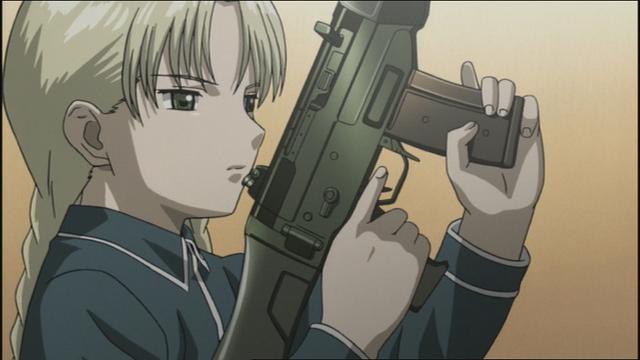
The emotional heart of the series is Henrietta (ヘンリエッタ) and Jose (ジョゼ). Their bond is often described in simple labels—romantic, parental, tragic—but the reality is more uncomfortable because it’s layered. Henrietta isn’t “in love” the way a free person chooses love. She is devoted in a way that feels inevitable, like gravity.
Jose’s care reads as sincere. He offers Henrietta the “small happiness” she craves: gentle attention, a sense of being seen, a pocket of normalcy in a life built for violence. But that sincerity is exactly what makes the relationship dangerous. The more humane he feels, the easier it becomes for Henrietta to anchor her entire self to him.
Here’s the nightmare: in a world with Conditioning, affection doesn’t just comfort—it programs. Even if Jose never intends to “own” Henrietta, the structure around them encourages a version of ownership. Her loyalty becomes absolute. His approval becomes oxygen. And the show dares you to admit the hardest truth: sometimes love can feel real and still be deeply unfree.
You can see it in the contrast the series draws. Henrietta’s softness can flip into terrifying efficiency the instant Jose is threatened. It’s not a “berserk mode” for spectacle. It’s the moment the audience realizes devotion has been shaped into a weapon—and the weapon is aimed at the world, but also at Henrietta’s own future.
Conditioning as the Theft of Choice, Not the Loss of Memory
Conditioning is often summarized as brainwashing, but the series’ cruelty is more specific than that. The horror isn’t only what the girls forget. It’s what they can no longer choose.
When loyalty is installed rather than earned, devotion becomes eerie. A girl can say “I want to protect you” and mean it—while also being unable to want anything else. That’s why the affection in GUNSLINGER GIRL feels so fragile: it’s always haunted by the question of authorship. Who wrote this feeling? Who benefits from it?
This is the series’ most piercing psychological move: it shows you emotions that are undeniably present, then forces you to look at the scaffolding underneath. In other words, the tragedy is not “they are machines.” The tragedy is “they are people—and the system learned how to use that.”
If you’re rewatching, pay attention to the moments that don’t look dramatic: a pause before a reply, a glance that lingers half a second too long, a soft line delivered like it’s a prayer. Those are the scenes where you can feel Choice slipping away, replaced by something smoother, cleaner… and far more violent.
Cyborg Bodies and the Quiet Horror of Being Useful
The “Gisutai” (義体)—the cybernetic body—isn’t a cool upgrade. It’s a symbol of stolen childhood. Yes, the girls gain strength, speed, and the ability to survive missions adults would hesitate to attempt. But the body is also a reminder that their lives were rerouted into utility.
There’s a special kind of despair in being designed to be effective. Pain becomes manageable. Damage becomes repairable. Even identity can become adjustable. And yet, the show keeps returning to tiny human rituals—music, hobbies, awkward jokes, the desire to be praised—because those rituals are the girls’ quiet proof that they are still here.
That’s where the “borrowed humanity” lands. The girls live like people, but on a borrowed timeline. Their normalcy is a loan. Their peace is a short-term agreement. The more the series lets you witness their gentleness, the more unbearable it becomes to remember why they exist in the first place.
Small Happiness as a Blade: Why the Soft Moments Hurt Most
Many dark stories go for shock. GUNSLINGER GIRL goes for contrast. It places warmth beside violence so closely that you start to understand what the girls are truly fighting for—not victory, but a few minutes of being allowed to feel safe.
That’s why “small happiness” doesn’t function as hope in the usual way. It functions as a blade. A shared snack, a quiet afternoon, a gentle conversation—these moments are precious precisely because they reveal what should have been possible. They show you a life that could have existed if the system hadn’t intervened.
And once you see that alternate life, the missions stop being “plot.” They become interruption. They become theft. The series doesn’t need to explain why the audience cries. It simply shows a child cherishing something ordinary—and then reminds you that the ordinary was never guaranteed.
How to Rewatch Without Looking Away From the Point
If you want to revisit GUNSLINGER GIRL and actually catch what makes it a psychological tragedy, try two small shifts in how you watch:
First, don’t ask “What is this relationship?” Ask “Where does it start to bend?” Watch for the instant care becomes dependence, and dependence becomes something the system can harvest.
Second, track the cost of Conditioning in the everyday scenes. The most important clues often appear when nobody is shooting: when a girl seeks approval, when an adult hesitates, when a line sounds tender but lands like a command.
In the end, GUNSLINGER GIRL leaves you with a question that feels almost too personal: if a person’s devotion can be engineered, what does “love” mean inside a cage?
Takeaway: This series endures because it doesn’t merely depict broken children—it depicts a world that knows exactly how to turn human softness into a mechanism. If you’re drawn to noir, tragedy, and stories that haunt rather than entertain, this is one of the rare anime that will stay with you long after the credits fade. 🕯️
Next step: Rewatch one episode focusing only on the “small happiness” scenes. Then rewatch the same episode focusing only on the Conditioning-shaped reactions. The emotional difference between those two passes is where the series’ truth lives.
(C)相田裕/メディアワークス・マーベラスAQL
✨✨✨More Anime You’ll Love:
 Chainsaw Man Season 2 is Real! International Assassins Arc Announced at Jump Festa 2026
 Aliens Check In, Humanity Checked Out: “Apocalypse Hotel” Manga Now Available
 “Boku no Weak Point” from Ensemble Stars!! Now Available for Global Streaming
 YOASOBI’s “Watch me!” Brings Magical Energy to WITCH WATCH Anime Opening