



























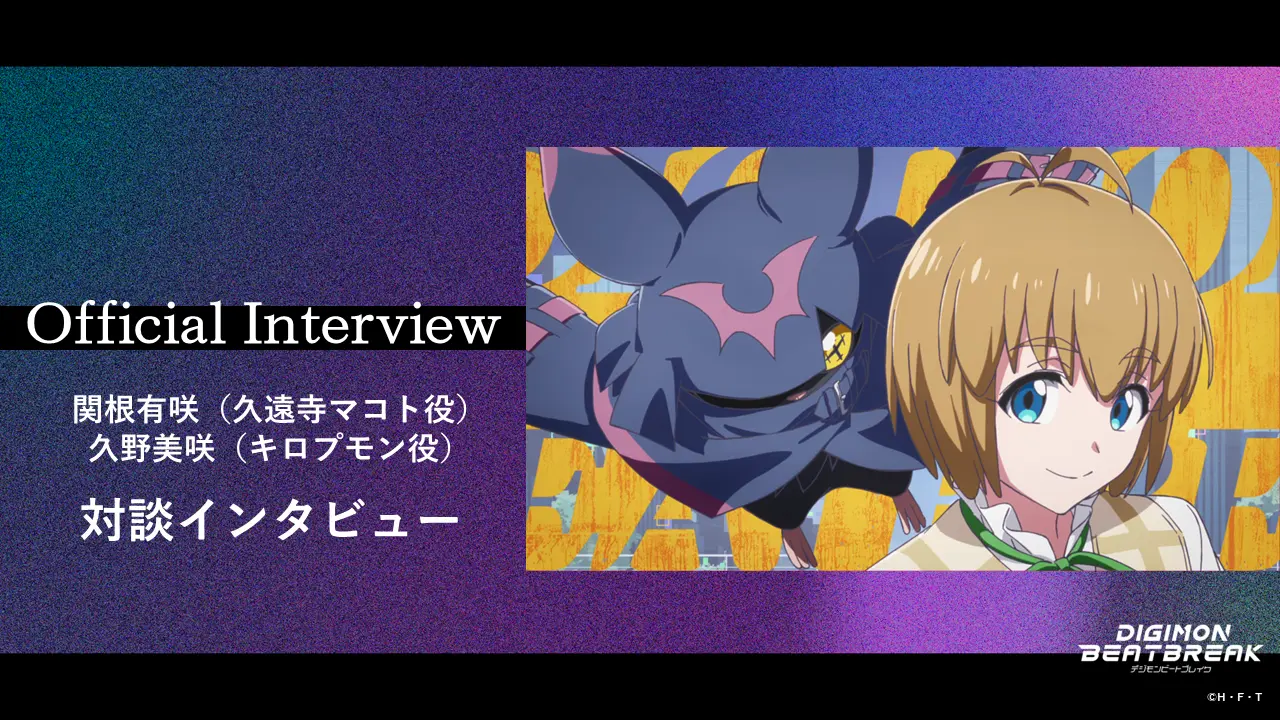
Arisa Sekine and Misaki Kuno sit down to talk about what makes Digimon Beatbreak feel like a “Digimon for right now.” As Makoto Kuonji and his partner Kilopmon reach a key evolution in episodes 9 and 10, the two actors unpack how they built this calm-but-wounded boy, the tiny Digimon born from his feelings, and the bond that lets them move forward together.
A Digimon That Feels Perfectly in Tune with Today’s World
— When you first heard about Digimon Beatbreak, what struck you most?
Sekine: When I first saw the setting and character designs, my reaction was, “Oh, this is for adults.” I grew up with Digimon Adventure, where the visuals felt very “for kids.” This time the art and color palette are more subdued and stylish, very Reiwa. It made me think, “So this is another way Digimon can look and feel.”
Kuno: My first thought was, “This is so cool.” Tomoro, our protagonist, is really delicate. He holds a lot of emotions inside instead of saying everything out loud, especially early on. That makes him incredibly human, and Miyu Irino’s performance brings that out even more. With AI-like Sapotama also in the mix, it feels close to our everyday life, but also like a slightly near future we can imagine.
Growing Up with Digimon and Finally Joining the Franchise
— Digimon is a long-running series. Did you get any reactions from people around you?
Kuno: On the day the cast was announced, friends from my school days messaged me like, “Congrats!” and “You’re in Digimon!?” You really feel how loved this franchise is when people who don’t normally text you suddenly show up just to celebrate.
Sekine: Same here! Friends I hadn’t talked to in ages suddenly went, “You’re in Digimon!?” It reminded me how many people have touched the franchise at least once. For me, Digimon Adventure and 02 were part of my childhood routine. Sunday mornings meant watching them with my siblings. I always wanted to be like Hikari—no logical reason, I just really admired her and dreamed of going on an adventure with my own partner Digimon. In a way, that dream finally came true.
Kuno: I watched Adventure and Tamers with my classmates back in elementary school. We’d talk about episodes in the classroom. I especially loved Terriermon—he was so cute.
Finding the Voices of Makoto and Kilopmon in the Audition Room
— How did you approach Makoto and Kilopmon in the audition stage?
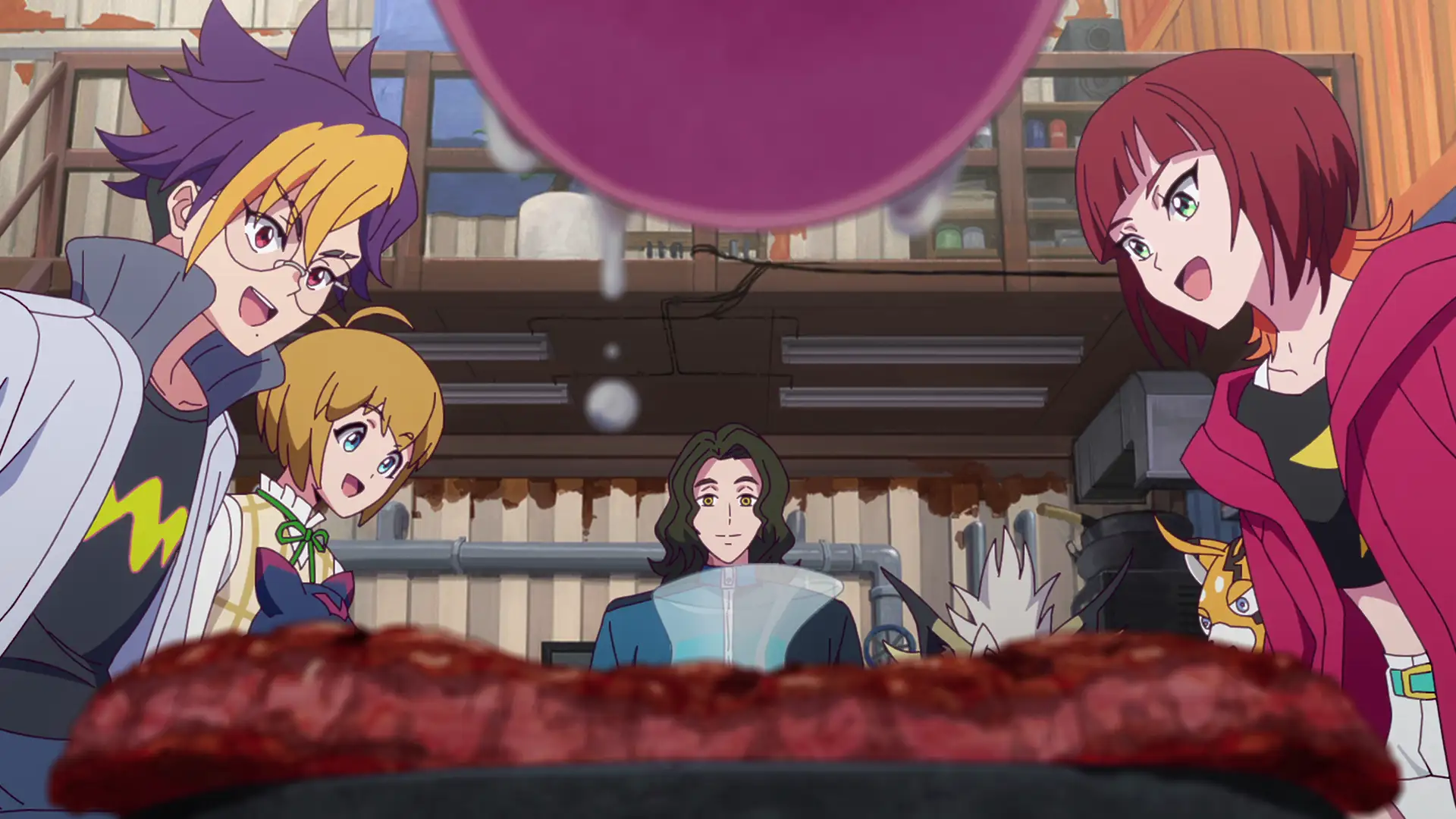
Sekine: I’ve played lots of boy roles, but I’d never really played someone like Makoto. When I saw his design, I honestly panicked a bit. He’s only ten, but very calm, smart, and a little detached. Most of my past boys were hot-blooded and straightforward. I wasn’t sure where in my “toolbox” this kid was hiding.
During the audition, the director gave me very specific notes like, “Try leaning more this way,” and something clicked. Makoto is ten, but his mental age is older. He talks with Tomoro and Rena like they’re equals, and he’ll state his opinion directly even to adults. I built the voice around that maturity, but I also wanted tiny flashes of “he’s still ten” to peek through when he’s just hanging out with friends.
— And Kilopmon?
Kuno: Funny story: the script I had before the studio audition was for another character entirely. When I got to the studio a bit early, I ran into Mutsumi Tamura. We’re friends, so we were chatting, and suddenly we were both pulled into a briefing about the show. That’s when I first saw Kilopmon’s design. I had to rely a lot on the director’s explanation and the visual impression, then just… go for it.
The core of Kilopmon hasn’t really changed since that day. We built the character together in the booth, and when we recorded episode 1 there were no big corrections—just “That’s good, keep it.” So Kilopmon now is basically the version born in that audition room.
Episodes 9 and 10: Painful Past, Evolution, and a Deeper Bond
— The episodes focusing on Makoto and Kilopmon’s past and evolution hit fans hard. How did you feel when you read those scripts?
Sekine: I was shocked that in this world, having a partner Digimon can be treated as something “bad.” For me, “having a partner Digimon = best thing ever,” so realizing there’s a world where that gets you driven out of your home felt really painful. But it also made Makoto make sense. He’s calm and responsible not just because of his “personality,” but because of what he’s carried.
He lost his place because of Kilopmon, but he never chose to abandon him. That kindness and resolve are what make Makoto such a compelling character to me.
Kuno: I naturally looked at it from Kilopmon’s point of view. If I were Kilopmon, I’d definitely feel guilty—like “Because of me, Makoto had to go through all this.” At the same time, their meeting is precious and irreplaceable. In Beatbreak, Digimon are born from human emotions, right? Your feelings are one-of-a-kind, and from that, one-of-a-kind Digimon are born.
There are partners in this show who don’t exactly get along, but Makoto and Kilopmon really do connect heart-to-heart. That kind of person—or partner—is rare even in real life, and I find that really beautiful.
— Night Kilopmon’s design also surprised people.
Kuno: I was surprised by how soon Kilopmon evolves—and before Gekkomon, too! The evolved form is so stylish and cool. Kilopmon feels like a boy, but also soft and a bit androgynous. Night Kilopmon’s design leans much more “masculine,” so in the first test I tried acting him with a much more “boyish” voice.
Then the director told me, “Don’t change the voice too much. Keep Kilopmon’s tone and just make the inside older.” So I shifted approach: same basic voice, but with more weight and maturity.
Sekine: Listening from the next mic, that version felt perfect. You can tell it’s still Kilopmon, but he’s clearly grown. I’m really excited to see the finished animation of Night Kilopmon in motion.
Studio Atmosphere, Cast Chemistry, and What to Watch Next
— What is the recording booth like for this show?
Sekine: I actually hadn’t worked with most of the cast before; I knew Mutsumi Tamura and Yohei Azakami from previous jobs, and that was it. I was nervous at first, but everyone is so kind and warm that the room quickly became a place where I could relax and be myself.
Kuno: Miyu Irino and Megumi Han are especially good at creating a friendly center. When I shout Kilopmon’s special move “Paralyze Echo!” in tests, they both smile at me, and Irino keeps jokingly copying the line—totally not sounding like Kilopmon, but it’s very cute. If we ever do an event, I’d love for fans to hear his version.
Outside the booth, the cast hangs out too—we even went to Round1 together. Sekine and I are both shy, so it took time, but we’ve gotten close enough to take silly two-shots together.
— Finally, a message for fans who loved episodes 9 and 10 and are looking forward to more.
Sekine: I’m truly happy that Makoto and Kilopmon’s bond deepened enough to reach Night Kilopmon. But while you’re cheering for them, please keep watching Tomoro and Gekkomon too—their path is far from easy. From here on out, every episode feels like, “Wait, it ends HERE!?” with cliffhangers that will have you yelling at the screen. There are plenty of exciting and heart-pounding scenes, so please stay with us every week.
Kuno: Focusing on those episodes let me really think about what Makoto means to Kilopmon. Kilopmon loves him and wants to stay with him, but that love can also be a burden. Wanting to become stronger for his sake is what leads to evolution. Even if the bond is solid from episode 1, relationships keep changing as you share more time together—that’s something I felt strongly while acting.
Beatbreak will keep adding new characters and getting louder and livelier. Please watch how Tomoro and Gekkomon’s relationship moves alongside Makoto and Kilopmon’s, and I hope you’ll enjoy every evolution along the way.
If you’re curious, you can jump into the main PV on YouTube and check broadcast details on the official Digimon Beatbreak site or the Digimon anime X account.
©本郷あきよし・フジテレビ・東映アニメーション
✨✨✨More Anime You’ll Love:
 Masakazu Morita on Ichigo, Hero Pebble Theory and Bleach’s 2026 Final Cour
 29-sai Dokushin Chūken Bōkensha no Nichijō — January 2026 Airing & New Cast Guide
 New Cast Announced for “Potion, Waga Mi o Tasukeru (ポーション、わが身を助ける)” as TOKYO MX Late-Night Slot Begins Oct 2
 GATE Season 2 Teaser Reveals a JMSDF–Submarine Arc at Sea